




Portrait of Prasenjit Karmakar

Prime Minister's Research Fellow

Prasenjit Karmakar

PhD Researcher, IIT Kharagpur

I am presently pursuing a Ph.D. in the Department of Computer Science and Engineering at the Indian Institute of Technology Kharagpur, India. I am a member of the UbiNet Lab. My doctoral research is supported by the PMRF.

Research interests

  • Sensing and HCI
  • Internet of Things
  • Distributed Systems
  • Machine Learning
  • Embodied AI and LLMs
  • Wearables
  • Prototype Design
  • Indoor Air Quality
  • Digital Health

Education

  • Ph.D., Computer Science and Engineering
    Indian Institute of Technology Kharagpur, IN
    2022 – Present
  • B.Tech., Computer Science and Engineering
    Maulana Abul Kalam Azad University of Technology, IN
    2016 – 2020

Experience

Doctoral Researcher
Kharagpur, India · Apr 2022 – Present
  • Technical writing
  • HCI and sensing research
  • Teaching assistantship
Visiting Researcher
Singapore · Jul 2025 – Jan 2026
  • Collaborative research
  • Embodied AI and LLMs
Systems Engineer
Bangalore, India · Nov 2020 – Apr 2022
  • Frontend development
  • Backend development
Research Intern
Durgapur, India · Sep 2019 – Sep 2020
  • Data analytics
  • Machine learning

Publications

2026

PoHAR: Understanding Hyperlocal Human Activities with Pollution Sensor NetworksFeatured

Prasenjit Karmakar, Karthik Reddy, Sandip Chakraborty

IEEE DCOSS-IoT 2026 · Jun 2026

Abstract

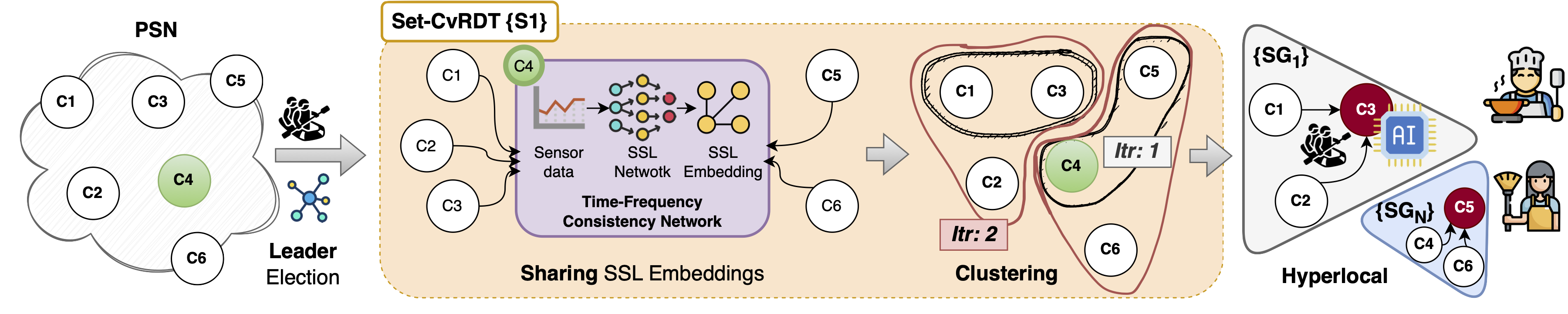
Low-cost air quality sensors are becoming ubiquitous in our daily lives as public awareness of air pollution continues to grow, and people take measures to monitor and improve the air they breathe indoors. Besides the standard operation of these sensors, fluctuations in environmental parameters can be leveraged to understand human behavior and activities in indoor spaces. Unlike traditional audio-visual, Radio Frequency, and inertial sensors, air quality sensors are easily scalable to a household, are privacy-preserving, and more economical. Such distributed sensor networks must jointly make decisions to monitor indoor occupants for downstream smart home and healthcare applications. However, due to low processing power, memory, and energy, they often struggle to maintain distributed data consensus and identify activity-affected sensor groups for accurate on-device inference. In this paper, we propose PoHAR framework that implements: (i) a conflict-free replicated data primitive for data sharing, (ii) a hierarchical clustering for ESP32 to detect activity-affected sensor groups with a self-supervised distance metric, and (iii) a leader-based group inference with off-the-shelf ML classifiers, enabling the sensor network to collaboratively detect hyperlocal indoor activities. Our extensive experiments demonstrated on-device activity detection, achieving 97.41% accuracy for indoor activity and 99.68% for cooking activity, using off-the-shelf ML models with latency below 34 microseconds.


2026

From Invisible to Actionable: Augmented Reality Interactions with Indoor CO2Featured

Prasenjit Karmakar, Manjeet Yadav, Swayanshu Rout, Swadhin Pradhan, Sandip Chakraborty

ACM CHI 2026 · Jan 2026

Abstract

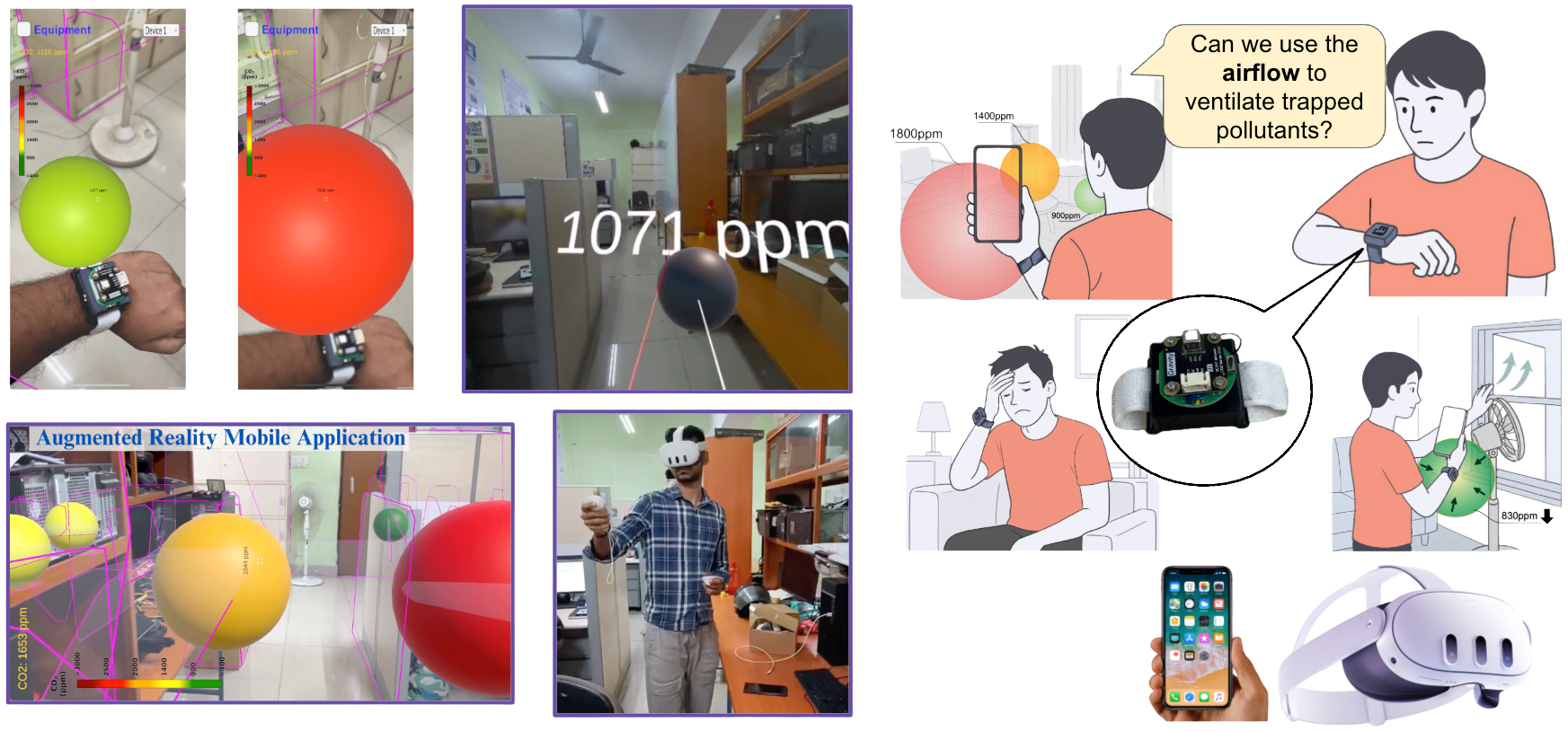
Indoor carbon dioxide (CO2) can rapidly accumulate to form invisible pollution hotspots, posing significant health risks due to its odorless and colorless nature. Despite growing interest in wearable or stationary sensors for pollutant detection, effectively visualizing CO2 levels and engaging individuals remains an ongoing challenge. In this paper, we develop a portable wrist-sized pollution sensor that detects CO2 in real time at any indoor location and reveals CO2 bubbles by highlighting sudden spikes. In order to promote better ventilation habits and user awareness, we also develop a smartphone-based augmented reality (AR) game for users to locate and disperse these high-CO2 zones. A user study with 35 participants demonstrated increased engagement and heightened understanding of CO2's health impacts. Our system's usability evaluations yielded a median score of 1.88, indicating its strong practicality.

2025

On-device Emotion Recognition from Spoken Language in Embedded Devices

Neeraj Boddeda, Sharvari Wanjari, Shashank Goud Boorgu, Prasenjit Karmakar, Sandip Chakraborty

IEEE PerCom 2025 (WIP) · Mar 2025

Abstract

Audio-based emotion recognition has many applications in human-computer interaction, mental health assessment, and customer service analytics. This paper presents a machine learning-based on-device emotion (i.e., anger, disgust, fear, happiness, neutrality, sadness, and surprise) recognition from audio for low-cost embedded devices. We show the influence of the speaker's mental state on various acoustic features, such as intensity, shimmer, etc. However, classifying the emotions from audio is challenging, as these emotions sound ambiguous for different speakers. Our extensive evaluation with lightweight machine learning models indicates an overall F1-score of 61.2% with below 50 ms response time and 256 KB memory usage in modern embedded devices.

2024

Indoor Air Quality Dataset with Activities of Daily Living in Low to Middle-income CommunitiesFeatured

Prasenjit Karmakar, Swadhin Pradhan, Sandip Chakraborty

NeurIPS 2024 · Oct 2024

Abstract

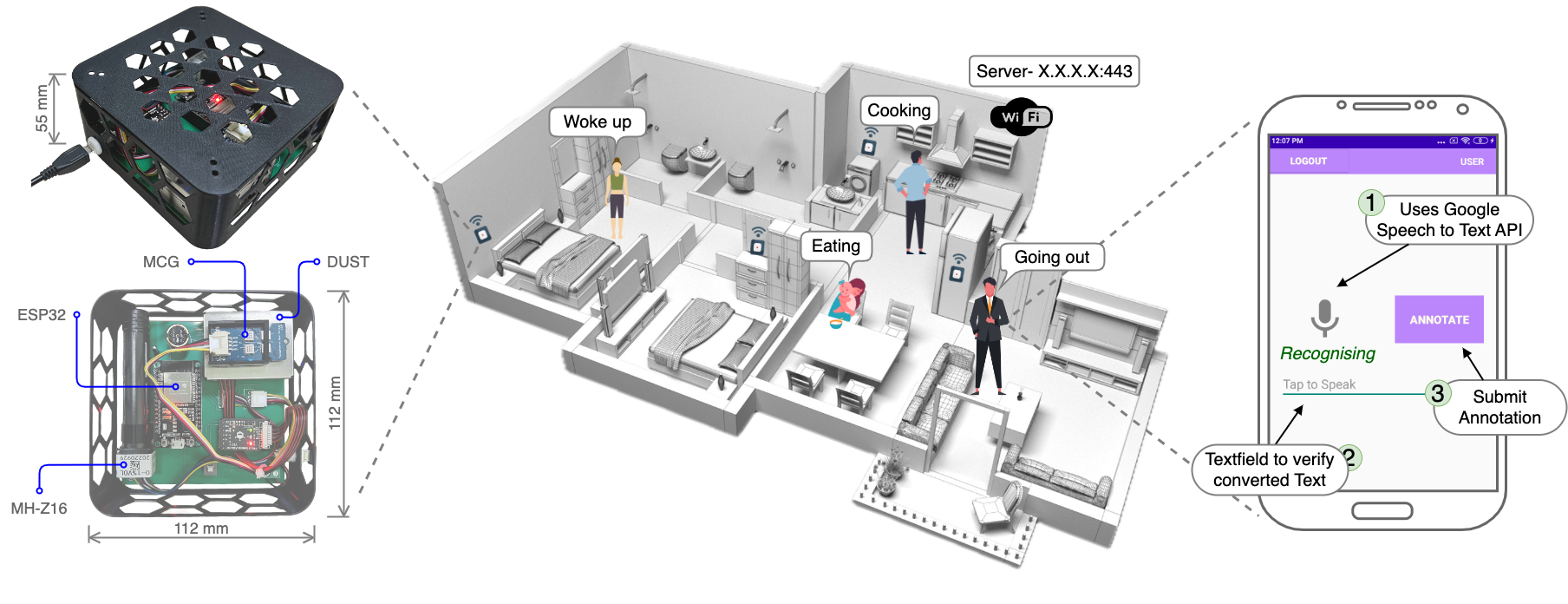
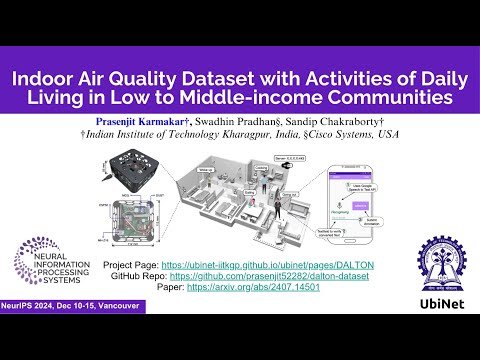
In recent years, indoor air pollution has posed a significant threat to our society, claiming over 3.2 million lives annually. Developing nations, such as India, are most affected since lack of knowledge, inadequate regulation, and outdoor air pollution lead to severe daily exposure to pollutants. However, only a limited number of studies have attempted to understand how indoor air pollution affects developing countries like India. To address this gap, we present spatiotemporal measurements of air quality from 30 indoor sites over six months during summer and winter seasons. The sites are geographically located across four regions of type: rural, suburban, and urban, covering the typical low to middle-income population in India. The dataset contains various types of indoor environments (e.g., studio apartments, classrooms, research laboratories, food canteens, and residential households), and can provide the basis for data-driven learning model research aimed at coping with unique pollution patterns in developing countries. This unique dataset demands advanced data cleaning and imputation techniques for handling missing data due to power failure or network outages during data collection. Furthermore, through a simple speech-to-text application, we provide real-time indoor activity labels annotated by occupants. Therefore, environmentalists and ML enthusiasts can utilize this dataset to understand the complex patterns of the pollutants under different indoor activities, identify recurring sources of pollution, forecast exposure, improve floor plans and room structures of modern indoor designs, develop pollution-aware recommender systems, etc.

2024

Passive Monitoring of Dangerous Driving Behaviors Using mmWave Radar

Argha Sen, Avijit Mandal, Prasenjit Karmakar, Anirban Das, Sandip Chakraborty

Pervasive and Mobile Computing · Oct 2024

Abstract

Detecting risky driving has been a significant area of focus in recent years. Nonetheless, devising a practical, effective, and unobtrusive solution remains a complex challenge. Presently available technologies predominantly rely on visual cues or physical proximity, complicating the sensing. With this incentive, we explore the possibility of utilizing mmWave radars exclusively to identify dangerous driving behaviors. Initially, we scrutinize the attributes of unsafe driving and pinpoint distinct patterns in range-doppler readings brought about by nine common risky driving manoeuvres. Subsequently, we create an innovative Fused-CNN model that identifies instances of hazardous driving amidst regular driving and categorizes nine distinct types of dangerous driving actions. After conducting thorough experiments involving seven volunteers driving in real-world settings, we note that our system accurately distinguishes risky driving actions with an average precision of approximately 97% with a deviation of ±2%. To underscore the significance of our approach, we also compare it against established state-of-the-art methods.

2024

Exploiting Air Quality Monitors to Perform Indoor Surveillance: Academic Setting

Prasenjit Karmakar, Swadhin Pradhan, Sandip Chakraborty

ACM MobileHCI 2024 · Sep 2024

Abstract

Changing public perceptions and government regulations have led to the widespread use of low-cost air quality monitors in modern indoor spaces. Typically, these monitors detect air pollutants to augment the end user's understanding of her indoor environment. Studies have shown that having access to one's air quality context reinforces the user's urge to take necessary actions to improve the air over time. Thus, user's activities significantly influence the indoor air quality. Such correlation can be exploited to get hold of sensitive indoor activities from the side-channel air quality fluctuations. This study explores the odds of identifying eight indoor activities (i.e., enter, exit, fan on, fan off, AC on, AC off, gathering, eating) in a research lab with an in-house low-cost air quality monitoring platform named DALTON. Our extensive data collection and analysis over three months shows 97.7% classification accuracy in our dataset.

2024

Exploring Indoor Air Quality Dynamics in Developing Nations: A Perspective from IndiaFeatured

Prasenjit Karmakar, Swadhin Pradhan, Sandip Chakraborty

ACM Journal on Computing and Sustainable Societies, Vol. 2, No. 3 · Sep 2024

Abstract

Indoor air pollution is a major issue in developing countries such as India and Bangladesh, exacerbated by factors such as traditional cooking methods, insufficient ventilation, and cramped living conditions, all of which elevate the risk of health issues such as lung infections and cardiovascular diseases. With the World Health Organization associating around 3.2 million annual deaths globally to household air pollution, the gravity of the problem is clear. Yet, extensive empirical studies exploring these unique patterns and indoor pollution's extent are missing. To fill this gap, we carried out a 6-months long field study involving over 30 households, uncovering the complexity of indoor air pollution in developing countries, such as the longer lingering time of volatile organic compounds (VOCs) in the air or the significant influence of air circulation on the spatiotemporal distribution of pollutants. We introduced an innovative Internet of Things (IoT) air quality sensing platform, the Distributed Air QuaLiTy MONitor (DALTON), explicitly designed to meet the needs of these nations, considering factors such as cost, sensor type, accuracy, network connectivity, power, and usability. As a result of a multi-device deployment, the platform identifies pollution hot spots in low- and middle-income households in developing nations. It identifies best practices to minimize daily indoor pollution exposure. Our extensive qualitative survey estimates an overall system usability score of 2.04, indicating an efficient system for air quality monitoring.

2024

Multimodal Sensing for Predicting Real-time Biking Behavior based on Contextual Information

Prasenjit Karmakar, Ajay Kumar Meena, Kushal Natani, Sandip Chakraborty

IEEE PerCom 2025 (WIP) · Mar 2024

Abstract

Overspeeding is a significant cause of road accidents, especially when the target vehicle is a two-wheeler. Coupled with infrastructural limitations and the general reckless driving behavior, it becomes challenging to reduce the problem of overspending, mainly because the optimal speed depends not only on road types but also on several spatiotemporal contexts. To mitigate this, in this paper, we propose Pathik, which uses multimodal contextual information to accurately predict the speeding behavior of a bike driver for the next road segment. Pathik then aggregates this information with the demographic and map-based information for the next road segment and recommends decelerating if the bike speed exceeds. Principled evaluation on an in-house dataset with different bike types (both geared and gearless) shows that Pathik can accurately predict the speed for the next patch with a mean R2-score of 0.92 (±0.015).

2023

mmDrive: mmWave Sensing for Live Monitoring and On-Device Inference of Dangerous DrivingFeatured

Argha Sen, Avijit Mandal, Prasenjit Karmakar, Anirban Das, Sandip Chakraborty

IEEE PerCom 2023 · Mar 2023

Abstract

Detecting dangerous driving has been of critical interest for the past few years. However, a practical yet minimally intrusive solution remains challenging as existing technologies heavily rely on visual features or physical proximity. With this motivation, we explore the feasibility of purely using mmWave radars to detect dangerous driving behaviors. We first study characteristics of dangerous driving and find some unique patterns of range-doppler caused by 9 typical dangerous driving actions. We then develop a novel Fused-CNN model to detect dangerous driving instances from regular driving and classify 9 different dangerous driving actions. Through extensive experiments with 5 volunteer drivers in real driving environments, we observe that our system can distinguish dangerous driving actions with an average accuracy of 97 (±2)%. We also compare our approach with existing state-of-the-art baselines to establish their significance.

2023

AQuaMoHo: Localized Low-cost Outdoor Air Quality Sensing over a Thermo-hygrometer

Prithviraj Pramanik, Prasenjit Karmakar, Praveen Kumar Sharma, Soumyajit Chatterjee, Abhijit Roy, Santanu Mandal, Subrata Nandi, Sandip Chakraborty, Mousumi Saha, Sujoy Saha

ACM Transactions on Sensor Networks, Vol. 19, No. 3 · Mar 2023

Abstract

Efficient air quality sensing serves as one of the essential services provided in any recent smart city. Mostly facilitated by sparsely deployed Air Quality Monitoring Stations (AQMSs) that are difficult to install and maintain, the overall spatial variation heavily impacts air quality monitoring for locations far enough from these pre-deployed public infrastructures. To mitigate this, we in this article propose a framework named AQuaMoHo that can annotate data obtained from a low-cost thermo-hygrometer (as the sole physical sensing device) with the AQI labels, with the help of additional publicly crawled Spatio-temporal information of that locality. At its core, AQuaMoHo exploits the temporal patterns from a set of readily available spatial features using an LSTM-based model and further enhances the overall quality of the annotation using temporal attention. From a thorough study of two different cities, we observe that AQuaMoHo can significantly help annotate the air quality data on a personal scale.

2023

Exploiting Multi-modal Contextual Sensing for City-bus's Stay Location Characterization: Towards Sub-60 Seconds Accurate Arrival Time Prediction

Ratna Mandal, Prasenjit Karmakar, Soumyajit Chatterjee, Debaleen Das Spandan, Shouvit Pradhan, Sujoy Saha, Sandip Chakraborty, Subrata Nandi

ACM Transactions on Internet of Things, Vol. 4, No. 1 · Feb 2023

Abstract

Intelligent city transportation systems are one of the core infrastructures of a smart city. The true ingenuity of such an infrastructure lies in providing the commuters with real-time information about citywide transport like public buses, allowing them to pre-plan their travel. However, providing prior information for transportation systems like public buses in real-time is inherently challenging because of the diverse nature of different stay-locations where a public bus stops. Although straightforward factors like stay duration extracted from unimodal sources like GPS at these locations look erratic, a thorough analysis of public bus GPS trails for 1,335.365 km at the city of Durgapur, a semi-urban city in India, reveals that several other fine-grained contextual features can characterize these locations accurately. Accordingly, we develop BuStop, a system for extracting and characterizing the stay-locations from multi-modal sensing using commuters' smartphones. Using this multi-modal information BuStop extracts a set of granular contextual features that allows the system to differentiate among the different stay-location types. A thorough analysis of BuStop using the collected in-house dataset indicates that the system works with high accuracy in identifying different stay-locations such as regular bus stops, random ad hoc stops, stops due to traffic congestion, stops at traffic signals, and stops at sharp turns. Additionally, we develop a proof-of-concept setup on top of BuStop to analyze the potential of the framework in predicting expected arrival time, a critical piece of information required to pre-plan travel at any given bus stop. Subsequent analysis of the PoC framework, through simulation over the test dataset, shows that characterizing the stay-locations indeed helps make more accurate arrival time predictions with deviations less than 60 seconds from the ground-truth arrival time.

2023

mmAssist: Passive Monitoring of Driver's Attentiveness Using mmWave Sensors

Argha Sen, Anirban Das, Prasenjit Karmakar, Sandip Chakraborty

COMSNETS 2023 · Jan 2023

Abstract

Continuous monitoring of driver attentiveness inside a car has been of significant importance for quite some time. However, the state-of-the-art techniques are primarily inclined toward image-based data, which is invasive and, therefore, could pose challenges in the pervasive adoption of such a system. This work proposes a novel approach for continuous driver attentiveness monitoring, leveraging millimeter Wave (mmWave) sensing to address that. The sensing infrastructure is compact, lightweight, and bears the exclusive potential to be adopted in a pervasive manner due to the continuously increasing popularity of mmWave hardware with 5G technology. We study the driver's attention as a multi-class problem and address that using Range Doppler information from an mmWave radar. We evaluate the proposed methodologies in a lab and a real-world driving scenario. Within the lab-based setup, we achieved an accuracy of 88%, whereas, in the real-world system, we could achieve an accuracy of up to 79% while monitoring the driver's activities associated with driving attentiveness. The source code is publicly available in GitHub.

2022

Reliable Backhauling in Aerial Communication Networks Against UAV Failures: A Deep Reinforcement Learning ApproachFeatured

Prasenjit Karmakar, Vijay K Shah, Satyaki Roy, Krishnandu Hazra, Sujoy Saha, Subrata Nandi

IEEE Transactions on Network and Service Management, Vol. 19, Issue 3 · Aug 2022

Abstract

Unmanned Aerial Vehicles (UAVs) can be utilized as aerial base stations to establish wireless communication networks in various challenging scenarios, such as emergency disaster areas and rural areas. Under large regions, the aerial communication networks would require UAVs to form wireless (backhaul) links among each other to provide end-to-end wireless services between two or more ground users (via one or more UAVs). Such UAV backhauling in aerial communication networks may be severely compromised if one or more UAVs are knocked off during the time of operation – it may be due to UAV hardware/software faults, limited battery, malicious attacks, etc. Deep reinforcement learning (DRL) has emerged as a powerful tool for learning tasks with large state and continuous action spaces. In this paper, we leverage emerging DRL to achieve reliable backhauling in an aerial communication network that remains functional and supports end-to-end wireless services even under various random and/or targeted UAV node failures. The proposed method (i) maximizes the reliability of UAV backhauling with joint consideration for communication coverage, (ii) learns the complex environment and its dynamics, and (iii) makes 3D positioning decisions for each UAV under the guidance of two deep neural networks. Our performance evaluation reveals that the proposed DRL approach outperforms the baseline method in terms of wireless coverage and network reliability against UAV failures.

2021

Can I Go for a Roof Walk Today? Know Your Housing's Air Quality from a Thermo-hygrometer

Praveen Kumar Sharma, Prasenjit Karmakar, Soumyajit Chatterjee, Abhijit Roy, Santanu Mandal, Sandip Chakraborty, Subrata Nandi, Sujoy Saha

ACM BuildSys 2021 · Nov 2021

Abstract

Smart cities are generally equipped with Air Quality Monitoring Stations (AQMS) as public infrastructure to have an overall perception of the air quality. However, the spatial density of the samples from the available public AQMS infrastructure is low, with a high cost of deployment and maintenance. Due to the spatial variation of the air quality and sparse deployment of AQMSs within a city, it is impossible to reliably obtain the air quality of a location far from a deployed AQMS. This paper provides a framework called AQuaMoHo that augments this existing system with a low-cost alternative that can even help the residents of a city to accurately monitor the air quality at any location in the town. AQuaMoHo relies on a low-cost thermo-hygrometer (THM) along with a GPS to populate various meteorological and demographic features, which are then used to predict the air quality reliably from any location. From a thorough study over two different cities, we observe that the proposed framework can significantly help annotate the air quality data at a personal scale.

2020

Ad-hocBusPoI: Context Analysis of Ad-hoc Stay-locations from Intra-city Bus Mobility and Smartphone Crowdsensing

Ratna Mandal, Prasenjit Karmakar, Abhijit Roy, Arpan Saha, Soumyajit Chatterjee, Sandip Chakraborty, Sujoy Saha, Subrata Nandi

ACM SIGSPATIAL 2020 (poster) · Nov 2020

Abstract

Public city bus services across various developing cities inhabit multiple stay-locations on the routes due to ad-hoc bus stops to provide on-demand passenger boarding and alighting services. Characterizing these stay-locations is essential to correctly develop models for bus transit patterns used in various digital navigation services. In this poster, we create a deep learning-driven methodology to characterize ad-hoc stay-locations over bus routes based on crowd-sensing contextual information. Experiments over 720km of bus travel data in a semi-urban city in India indicate promising results from the model in terms of good detection accuracy.

No publications match your search.

Many Pollutants, One Wearable

See the research behind PoWear

DALTON, Pollution Dynamics, CoWear, and PoHAR, spanning years of peer-reviewed work at the UbiNet Lab led to the wristband you can wear today.

View Research

News

Teaching20 Jul 2026

TA for Reinforcement Learning at IIT Madras

Organizing live interaction sessions for the NPTEL course — Reinforcement Learning.

Read more

Offering Teaching Assistantship in Reinforcement Learning, IIT Madras NPTEL Course in Autumn 2026 semester. The course will provide:

  • Intermediate level knowledge of python programming language
  • Hands-on problem solving experience (case-studies) with various open source libraries such as numpy, pandas, matplotlib, tensorflow, pytorch, etc.

Prerequisites: Basic concepts of programming, beginner level C.
Mode: Online, every Sunday, 5:00 PM – 7:00 PM (24 hours in total)

Achievements17 Sep 2025

Google Award on Society-Centered AI 2025

A much needed recognition during my PhD journey.

Read more

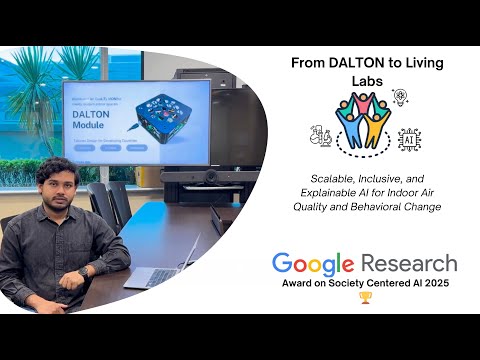
DALTON project received the Award in 2023 and again in 2025 for extending the platform to living labs. The Society-Centered approach involves understanding societal needs and challenges facing diverse communities around the globe, developing useful technologies or innovations that are responsive to these needs together with the communities impacted, and measuring the success by the impact on those communities. Crucially, the approach involves collective efforts that bring together multiple stakeholder groups, often through direct partnership with organizations that can represent the perspectives and needs of impacted communities.

  • Society-Centered AI will fund research projects that promote the society-centered research approach to shape the positive outcomes of AI for a better future. We are seeking research proposals that advance AI applications relating to accessibility, health care, cultural production, upskilling, or other topics related to the United Nations' 17 Sustainable Development Goals.
  • Project title: From DALTON to Living Labs: Scalable, Inclusive, and Explainable AI for Indoor Air Quality and Behavioral Change — Sandip Chakraborty (PhD Advisor), IIT Kharagpur
Teaching20 Jul 2025

Offering Introduction to Computing with Python

Teaching an intermediate-level Python course.

Read more

Offering Introduction to Computing with Python in the coming semester. The course will provide 25–30 hours of content in total on the following:

  • Intermediate level knowledge of python programming language
  • Hands-on problem solving experience (case-studies) with various open source libraries such as numpy, pandas, matplotlib etc.

Prerequisites: Basic concepts of programming, beginner level C.
Run 1: Bengal College of Engineering and Technology Durgapur, online from 25 Jun 2023, 2:00 PM
Run 2: NPTEL (The Joy of Computing using Python), online from 20 Jul 2024, 6:00 PM
Run 3: Government College of Engineering Kishanganj, online from 20 Jul 2025, 5:00 PM

Teaching29 Jan 2025

TA for Introduction to Machine Learning at IIT Madras

Organizing live interaction sessions for the NPTEL course — Introduction to Machine Learning.

Read more

Offering Teaching Assistantship in Introduction to Machine Learning, IIT Madras NPTEL Course in Spring 2025 semester. The course will provide:

  • Intermediate level knowledge of python programming language
  • Hands-on problem solving experience (case-studies) with various open source libraries such as numpy, pandas, matplotlib, tensorflow, pytorch, etc.

Prerequisites: Basic concepts of programming, beginner level C.
Mode: Online, every Saturday, 6:00 PM – 8:00 PM (26 hours in total)

Teaching22 Oct 2024

TA for The Joy of Computing Using Python at IIT Ropar

Organizing live interaction sessions for the NPTEL course — The Joy of Computing using Python.

Read more

Offering Teaching Assistantship in The Joy of Computing using Python, IIT Ropar NPTEL Course in Fall 2024 semester. The course will provide:

  • Intermediate level knowledge of python programming language
  • Hands-on problem solving experience (case-studies) with various open source libraries such as numpy, pandas, matplotlib etc.

Prerequisites: Basic concepts of programming, beginner level C.
Mode: Online, every Tuesday, 6:00 PM – 8:00 PM (26 hours in total)

Achievements07 Oct 2023

Google Award for Inclusion Research 2023

A much needed encouragement to work on indoor air quality.

Read more

The Award for Inclusion Research (AIR) Program supported innovative research and professors working to create positive societal impact.

  • AIR funded research projects that promote the society-centered research approach to shape the positive outcomes of AI for a better future. We are seeking research proposals that advance AI applications relating to accessibility, health care, cultural production, upskilling, or other topics related to the United Nations' 17 Sustainable Development Goals.
  • Project title: AI-assisted Distributed Collaborative Indoor Pollution Meters: A Case Study, Requirement Analysis, and Low-cost Healthy Home Solution for Indian Slums — Sandip Chakraborty (PhD Advisor), IIT Kharagpur
Achievements27 Mar 2023

Prime Minister's Research Fellowship Received

A much needed fellowship during my PhD journey.

Read more

The Prime Minister's Research Fellows (PMRF) Scheme has been designed for improving the quality of research in various higher educational institutions in the country. The institutes which can offer PMRF include all the IITs, all the IISERs, Indian Institute of Science, Bengaluru and some of the top Central Universities/NITs that offer science and/or technology degrees.

  • The candidates are selected through a rigorous selection process and their performance is reviewed suitably through a national convention.